
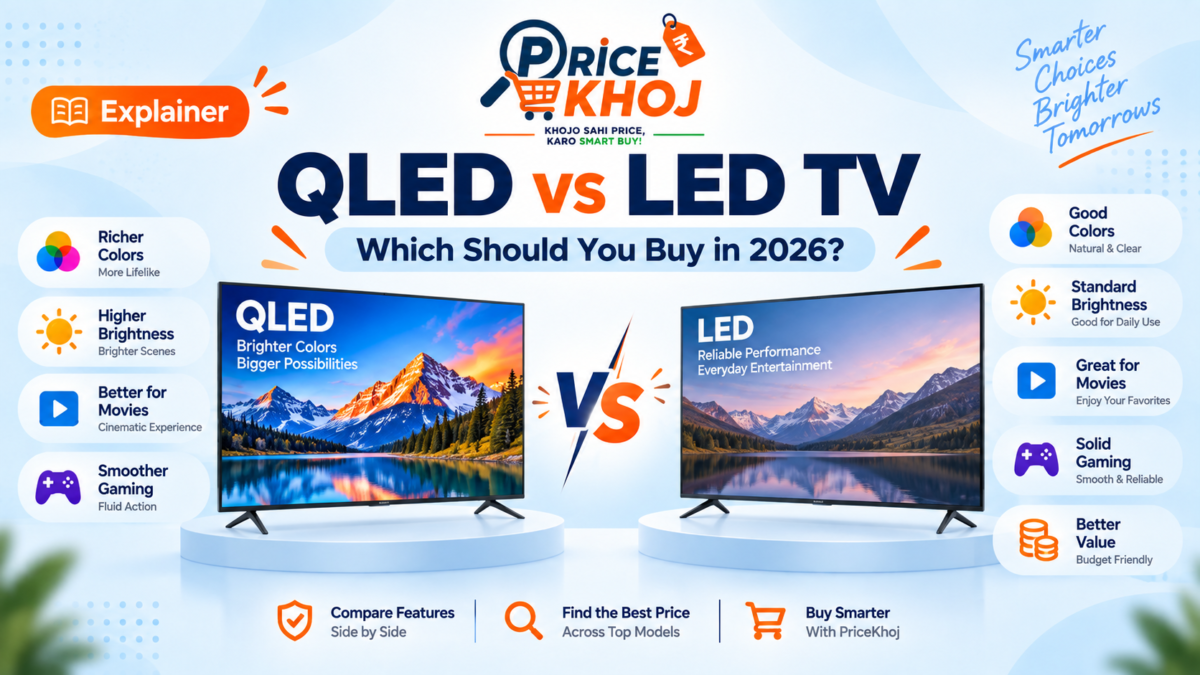
QLED vs LED TV is one of the most common questions buyers face because both names can appear on TVs that look very similar from the outside. The practical difference is that a QLED TV uses a quantum-dot layer to improve colour performance, while a standard LED TV generally relies on a conventional LCD panel with LED backlighting. That does not automatically make every QLED better than every LED, because processing, brightness, panel quality, local dimming and software also matter.
QLED vs LED TV: simple explanation
Most TVs sold as LED or QLED are still LCD televisions. The difference is mainly in how colour and backlighting are handled. A QLED television adds quantum-dot technology, which is designed to produce a wider and more vivid colour range. A normal LED TV can still look excellent, especially when the panel and picture processing are good.
| Factor | LED TV | QLED TV |
|---|---|---|
| Colour | Good on decent panels | Usually wider/richer colour |
| Brightness | Varies by model | Often marketed for higher colour brightness |
| Price | Usually lower | Usually costs more |
| Best for | General TV and budget buyers | Movies, HDR and colour-focused buyers |
Where QLED gives a real advantage
QLED makes the most sense when you care about colour volume, HDR content and a more premium-looking image. TCL, Xiaomi, Samsung and other brands use quantum-dot technology in different price bands, so the label is no longer limited to premium TVs. In current Indian pricing, some 43-inch QLED models are already close to regular LED prices.
Where a normal LED TV can still be the smarter buy
If your use is mainly news, YouTube, sports, DTH and casual OTT viewing, a good 4K LED TV can be enough. The money saved can be used for a soundbar, larger screen size or extended warranty. A well-tuned LED TV from a reliable brand may be a better purchase than a cheap QLED with weak processing or poor service support.
QLED vs LED for movies
For movies, QLED generally has the advantage when the model offers strong HDR support and good brightness. Richer colour can make animation, nature content and HDR streaming more engaging. However, contrast depends heavily on the backlight system. A QLED TV without good local dimming can still struggle with deep blacks in a dark room.
QLED vs LED for sports
Sports buyers should not choose only by QLED branding. Motion handling, refresh rate and processing matter more. A 60Hz QLED with average motion can be less satisfying than a better-tuned LED TV. Look for motion interpolation, DLG/high-refresh modes where relevant and a panel that remains clear during fast camera movement.
QLED vs LED for gaming
Gaming depends on HDMI features, ALLM, VRR and actual refresh-rate support. QLED can improve colour, but it does not guarantee lower input lag or smoother gameplay. Console users should check whether the TV supports 120Hz, VRR and eARC on the exact HDMI port they plan to use.
What about Mini-LED?
Mini-LED is not the same thing as QLED. Mini-LED describes the backlight system, using many smaller LEDs for more precise light control. QLED describes the quantum-dot colour layer. A television can combine both technologies, which is why some QD Mini-LED models sit above standard QLED TVs in the display hierarchy.
Which should you buy in 2026?
- Choose LED if: budget matters most, your use is general TV/OTT, or you can get a larger screen for the same money.
- Choose QLED if: colour quality and HDR matter and the price gap is reasonable.
- Choose Mini-LED/QD Mini-LED if: you want stronger contrast control and are willing to spend more.
CHECK 43-INCH QLED TVS ON AMAZON CHECK 55-INCH 4K TVS ON AMAZON
QLED vs LED TV: FAQs
Is QLED always better than LED?
No. QLED gives a colour-related technology advantage, but overall picture quality still depends on panel quality, processing, brightness and backlighting.
Does QLED have burn-in risk?
QLED TVs are LCD-based, so they do not have the same pixel-level burn-in behaviour associated with self-emissive OLED panels.
Is QLED worth it under ₹30,000?
It can be, especially when a 43-inch QLED is only slightly more expensive than a similar 4K LED model. Compare the exact feature set rather than the label alone.
What is better for bright rooms?
A brighter TV with good anti-reflection behaviour is preferable. Many QLED models target strong colour brightness, but check model-specific brightness rather than assuming.
QLED vs LED by budget: where should you spend more?
Below about ₹25,000, screen size and basic 4K quality may matter more than display branding. In the ₹25,000–₹40,000 range, QLED becomes easier to justify because the price gap can be small and several brands add better smart-TV hardware at the same time. Above that, do not stop at the word QLED: compare local dimming, Mini-LED backlighting, peak brightness and refresh-rate support. The best upgrade is the one you can actually see in your room and content, not the longest feature list.
If your room is bright during the day, prioritise brightness and reflection handling. If you mostly watch movies at night, contrast and backlight control become more important. This simple use-case test is often more useful than choosing a display technology in isolation.