
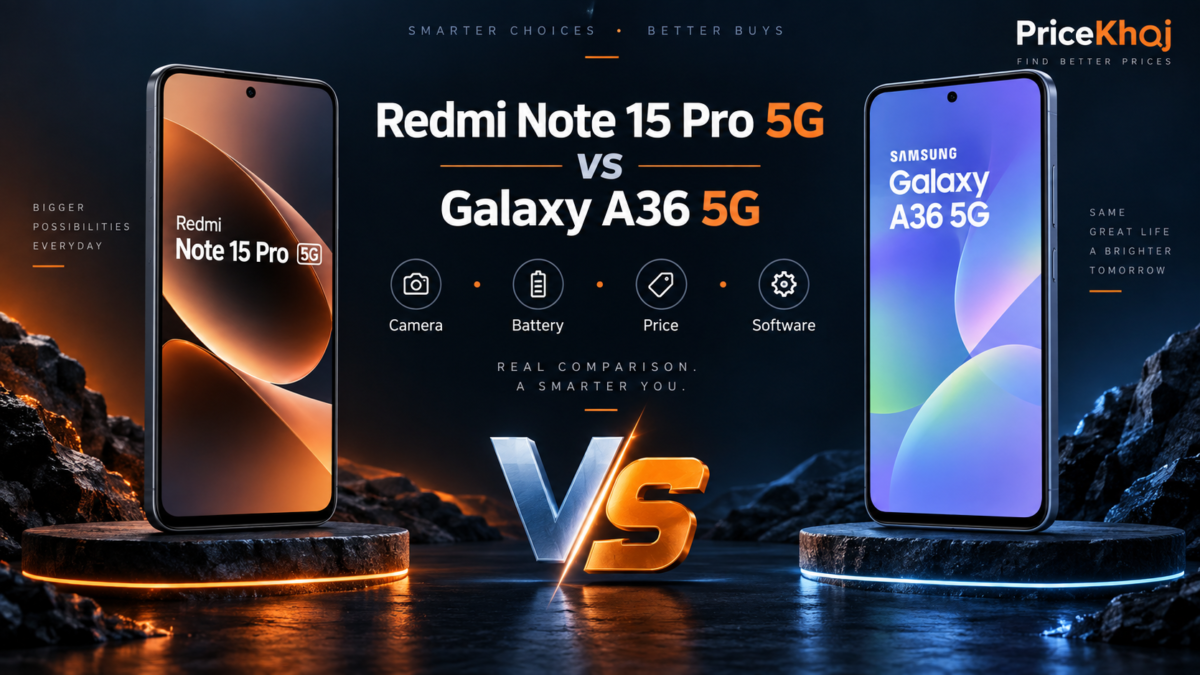
Redmi Note 15 Pro 5G vs Samsung Galaxy A36 5G is a close mid-range comparison, but the two phones prioritise different things. Redmi focuses on camera hardware, battery capacity and durability, while Samsung focuses on long software support, a lighter body and the Galaxy ecosystem.
Best for camera + battery + durability
Recent price reference: ₹31,999
Main camera: 200MP OIS
Battery: 6,580mAh
Protection: IP66/IP68/IP69/IP69K
Best for software support + Galaxy ecosystem
Recent price reference: ₹28,000
Main camera: 50MP OIS
Battery: 5,000mAh
Support: 6 OS generations + 6 years security
Redmi Note 15 Pro 5G vs Samsung Galaxy A36 5G price in India
Price is the first major difference. Recent Indian price references checked in September 2026 list the Redmi Note 15 Pro 5G from about ₹31,999, while the Samsung Galaxy A36 5G starts around ₹28,000. These are market references, not guaranteed checkout prices. Amazon pricing, seller stock, card offers and storage variants can change quickly.
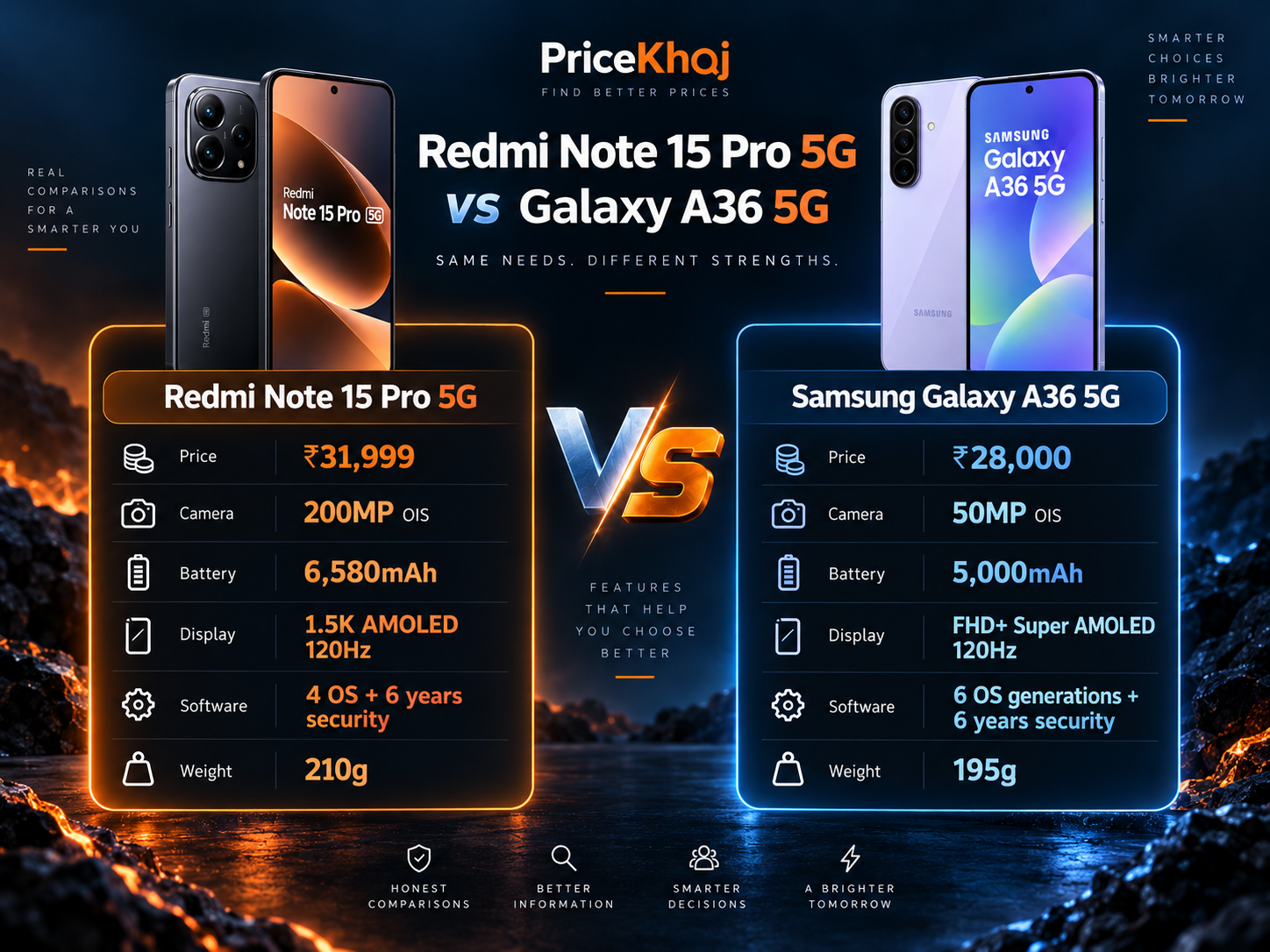
| Feature | Redmi Note 15 Pro 5G | Samsung Galaxy A36 5G |
|---|---|---|
| Recent price reference | ₹31,999 | ₹28,000 |
| Display | 6.83-inch 1.5K AMOLED, 120Hz | 6.7-inch FHD+ Super AMOLED, 120Hz |
| Processor | MediaTek Dimensity 7400-Ultra | Octa-core processor |
| Main camera | 200MP OIS + 8MP ultra-wide | 50MP OIS + 8MP ultra-wide + 5MP macro |
| Front camera | 20MP | 12MP |
| Battery | 6,580mAh | 5,000mAh |
| Charging | 45W | 45W Super Fast Charge |
| Protection | IP66/IP68/IP69/IP69K, Gorilla Glass Victus 2 | IP67, Gorilla Glass Victus+ |
| Weight | 210g | 195g |
| Software support | 4 OS updates + 6 years security | 6 OS generations + 6 years security |
Quick specification comparison
The Redmi Note 15 Pro 5G is the more specification-heavy phone on paper: a higher-resolution main camera, larger battery, sharper display resolution and broader ingress-protection ratings. The Galaxy A36 5G counters with a lighter body, Samsung’s software ecosystem and a longer advertised major-OS upgrade policy.
Display: 1.5K Redmi panel vs Samsung Super AMOLED
Xiaomi gives the Redmi Note 15 Pro 5G a 6.83-inch AMOLED display with a 2772×1280 resolution and up to 120Hz refresh rate. Xiaomi also advertises HDR10+, Dolby Vision and a peak brightness figure of up to 3,200 nits under specified conditions.
Samsung’s Galaxy A36 5G uses a 6.7-inch FHD+ Super AMOLED display with a 120Hz refresh rate and up to 1,200 nits brightness. The Redmi is sharper on paper, while Samsung’s panel remains a strong fit for everyday media, scrolling and outdoor use.
Camera: 200MP Redmi vs 50MP Samsung
The Redmi Note 15 Pro 5G has a 200MP OIS main camera plus an 8MP ultra-wide camera and supports 4K video. Samsung uses a 50MP OIS main camera, 8MP ultra-wide and 5MP macro camera, along with a 12MP front camera and 4K video recording.
The Redmi has the stronger headline camera specification, especially for buyers who value high-resolution capture and cropping flexibility. Samsung offers a more conventional triple-camera setup. Camera quality still depends on processing, lighting and shooting style, so megapixels alone should not decide the purchase.
Performance and daily use
The Redmi Note 15 Pro 5G uses the MediaTek Dimensity 7400-Ultra, built on a 4nm process. Xiaomi lists up to 8GB RAM and 256GB storage for the India model. The Galaxy A36 5G uses an octa-core processor and is available in multiple memory and storage configurations.
For normal social apps, streaming, navigation and multitasking, both target the upper mid-range segment. Gaming buyers should also compare sustained performance and thermals rather than only chipset names.
Battery and charging: Redmi has the capacity advantage
Battery capacity is one of the biggest differences. Redmi provides a 6,580mAh battery and 45W charging, while Samsung provides a 5,000mAh battery with 45W Super Fast Charging. Samsung advertises up to 29 hours of video playback for the Galaxy A36 5G.
Durability and build
Xiaomi lists IP66, IP68, IP69 and IP69K ratings for the Redmi Note 15 Pro 5G under specified laboratory conditions, along with Gorilla Glass Victus 2. Samsung lists IP67 protection and Gorilla Glass Victus+ for the Galaxy A36 5G.
These certifications are useful, but neither phone should be treated as waterproof. Water resistance can decrease with physical damage, wear or disassembly.
Software support: Samsung’s strongest advantage
Samsung advertises 6 generations of OS upgrades and 6 years of security updates for the Galaxy A36 5G. Xiaomi advertises 4 years of OS updates and 6 years of security updates for the Redmi Note 15 Pro 5G.
If you keep a phone for four to six years, this difference can matter more than a single camera or benchmark specification.
Pros and cons
Redmi Note 15 Pro 5G
Pros
- 200MP OIS main camera
- 6,580mAh battery
- 1.5K 120Hz AMOLED display
- Strong ingress-protection specifications
- Gorilla Glass Victus 2
Consider
- Heavier at around 210g
- Shorter advertised major-OS support than Samsung
Samsung Galaxy A36 5G
Pros
- 6 OS generations + 6 years security updates
- 120Hz Super AMOLED display
- 50MP OIS main camera
- 195g body
- Galaxy ecosystem and Samsung Knox features
Consider
- Smaller battery than Redmi
- Lower-resolution main camera on paper
Redmi Note 15 Pro 5G vs Samsung Galaxy A36 5G: which one fits you?
Also compare the current transaction price. If one model receives a major Amazon or bank discount, the value equation can change quickly. See our best 5G phones around ₹30,000 guide and latest buying guides for more alternatives.
Redmi Note 15 Pro 5G vs Samsung Galaxy A36 5G: final comparison summary
Redmi Note 15 Pro 5G vs Samsung Galaxy A36 5G comes down to priorities. Redmi gives you the larger battery, 200MP OIS main camera, sharper 1.5K AMOLED panel and stronger protection ratings on paper. Samsung Galaxy A36 5G gives you a lighter body, the Galaxy software ecosystem and the longer advertised major-OS upgrade policy. Compare the live Amazon price for the exact RAM/storage variant before deciding.
For more options, see our best 5G phones under ₹30,000 guide and the realme P4 Power 5G vs Redmi Note 15 Pro 5G comparison.
Frequently asked questions
Which is better: Redmi Note 15 Pro 5G vs Samsung Galaxy A36 5G?
Neither is universally better. Redmi is stronger on battery capacity, camera resolution and durability specifications, while Samsung emphasizes longer major-OS support, a lighter body and the Galaxy ecosystem.
Which has the bigger battery: Redmi Note 15 Pro 5G or Galaxy A36 5G?
The Redmi Note 15 Pro 5G has the larger battery at 6,580mAh, compared with 5,000mAh on the Galaxy A36 5G.
Which phone has the higher-resolution main camera?
The Redmi Note 15 Pro 5G has a 200MP OIS main camera, while the Galaxy A36 5G uses a 50MP OIS main camera.
Which phone gets longer software support?
Samsung advertises six generations of OS upgrades and six years of security updates for the Galaxy A36 5G. Xiaomi advertises four years of OS updates and six years of security updates for the Redmi Note 15 Pro 5G.
Which one is lighter?
The Galaxy A36 5G is lighter at 195g. Xiaomi lists the Redmi Note 15 Pro 5G at 210g.
Should I buy based only on the lowest price?
No. Compare the exact RAM/storage variant, seller, warranty, card offer, return terms and final checkout price before buying.
Both phones have separate Amazon affiliate buttons so you can check each current offer independently. Price, stock and seller terms can change on the merchant website.
Official specification sources:
Xiaomi India – Redmi Note 15 Pro 5G |
Samsung India – Galaxy A36 5G.
Market price references were checked in September 2026 and may change.